Best Time to Post on TikTok in 2026
The major studies contradict each other. Here is what they actually say, and how to apply it to your region.
What the Data Says
Sprout Social's 2026 study is the largest dataset available on TikTok posting times: 2 billion engagements analyzed across 307,000 global profiles between November 2025 and February 2026. The findings are consistent across industries.
Best days: Tuesday, Wednesday, and Thursday. Mid-week is when TikTok users are most active and scroll with more intent, commuting, lunch breaks, and evening wind-down all concentrate into these days.
Best window: 2pm–6pm in your audience's local time. Wednesday has the widest peak (1pm–8pm). Tuesday is the single strongest individual day.
Worst days: Saturday and Sunday consistently underperform. Weekend scrolling is more passive and less sustained than weekday behavior.
Safe starting point: Post on Tuesday or Wednesday between 2pm and 6pm in your audience's timezone. Run it for 4 weeks, then adjust based on your TikTok Analytics follower activity data.
Best Times by Day of Week
| Day | Best window (local time) | Engagement level |
|---|---|---|
| Monday | 3 pm – 5 pm | Good |
| Tuesday | 2 pm – 6 pm | Peak |
| Wednesday | 1 pm – 8 pm | Peak |
| Thursday | 1 pm – 5 pm | High |
| Friday | 3 pm – 5 pm | Moderate |
| Saturday | — | Low |
| Sunday | — | Low |
Source: Sprout Social 2026, 2 billion engagements, 307,000 global profiles, November 2025 to February 2026. All times in your audience's local timezone.
Best Times by Region
The global baseline (Tue–Thu, 2pm–6pm) applies in your audience's local time, not yours. Here is how that translates across the major markets, combined with known local usage patterns.
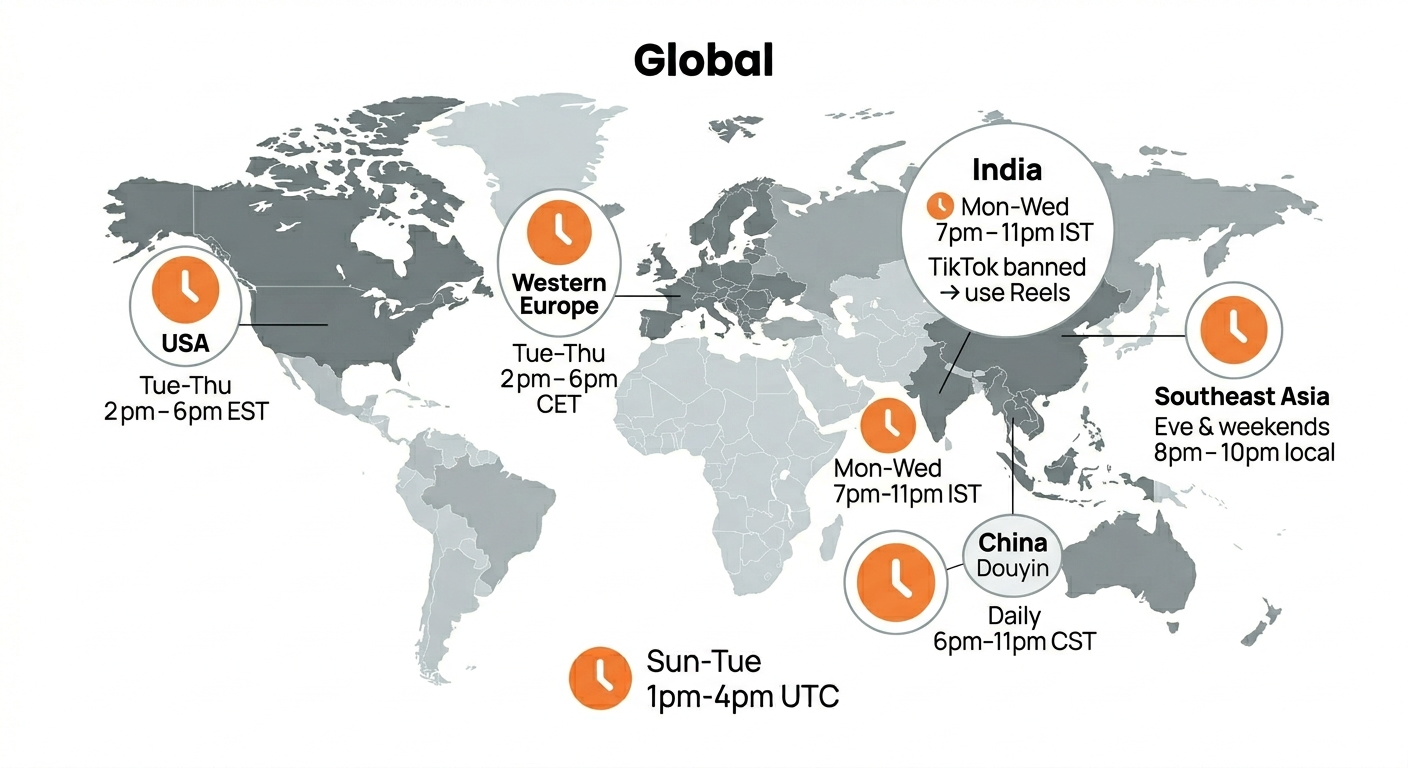
USA
The US is TikTok's largest English-speaking market and the primary audience for most third-party studies. The Sprout Social baseline applies most directly here.
Primary window: Tuesday–Thursday, 2pm–6pm EST. This is the Sprout Social baseline in US Eastern Time, the most data-backed starting point available.
Secondary windows worth testing: 7am–9am EST (morning commute scrolling) and 7pm–9pm EST (prime-time relaxation). Buffer's data suggests evenings outperform afternoons for engagement rate, test both windows over 4+ weeks and let your own analytics decide.
US-specific note: PST creators targeting a national US audience should post 3 hours earlier than EST windows, 11am PST = 2pm EST. If 70%+ of your audience is West Coast, shift accordingly using your follower activity data.
Western Europe (UK, Germany, France)
Western Europe is 5–6 hours ahead of US Eastern Time. The global Sprout baseline (2pm–6pm local) applied to Western Europe means posting at 2pm–6pm CET, the same afternoon window, just in European time. No separate European TikTok study exists.
CET primary window: Tuesday–Thursday, 2pm–6pm CET. This is the direct timezone translation of the global baseline. The UK equivalent is 1pm–5pm GMT/BST.
Morning window: 7am–9am local time is worth testing for European audiences. TikTok has strong commute-time usage in urban European markets, a pattern that does not necessarily appear in global aggregates dominated by US behavior.
French exception: France shows elevated weekend TikTok engagement compared to other European markets, particularly Saturday evening. If France is a significant part of your audience, Buffer's weekend data may be more applicable than Sprout's.
Cross-European shortcut: 8pm–9pm CET (7pm–8pm GMT) is a single slot that falls in the evening window for all major Western European markets simultaneously, useful if you have a mixed European audience and can only pick one time.
Southeast Asia
Southeast Asia is one of TikTok's highest-engagement regions globally. Indonesia is a top-three market by total users. The Philippines, Vietnam, Thailand, and Malaysia all show TikTok usage deeply embedded in daily routines. No SEA-specific TikTok timing study exists from the major sources, but known usage patterns point clearly to evening as the primary window.
Evening window (primary): 8pm–10pm local time consistently appears as the strongest window across the region. This is later than the Sprout global baseline and reflects the evening-heavy scrolling behavior common in Southeast Asian markets.
Indonesia (WIB, UTC+7): 12pm–2pm WIB (lunch) and 8pm–10pm WIB (evening) are the two clear windows. Indonesian TikTok also shows meaningful weekend engagement, Saturday and Sunday afternoons perform in a way they do not in Western markets, which aligns with Buffer's weekend findings more than Sprout's.
Philippines (PST, UTC+8): Late evening usage is particularly high, 9pm–11pm PST. Filipino TikTok users scroll later than most other markets.
Cross-SEA anchor: Post at 8pm–10pm WIB (UTC+7). That window covers the evening slot for Indonesia and Vietnam simultaneously, with the Philippines one hour behind.
India: TikTok Is Banned
TikTok was permanently banned in India in June 2020. The ban has not been reversed. With 1.4 billion people, India is not reachable via TikTok, the app is unavailable on Indian app stores and blocked at the network level.
The Indian short-form video market moved to Instagram Reels and YouTube Shorts after the ban. If your target audience includes India, those are the platforms to focus on. Instagram Reels timing for India follows similar patterns to TikTok globally, 7am–9am IST and 7pm–9pm IST tend to perform well.
If you are targeting the Indian diaspora in the US, UK, UAE, or Canada, standard TikTok timing for those markets applies, you are reaching them where they live, not in India.
China: TikTok vs. Douyin
TikTok does not operate in China. ByteDance runs Douyin (抖音) as a completely separate platform for the Chinese market, separate algorithm, separate content moderation, separate creator ecosystem. A TikTok post does not appear on Douyin, and vice versa.
If your goal is to reach audiences inside China, TikTok is not the right tool. Douyin requires a Chinese phone number and operates under Chinese content rules.
If you see "China" in your TikTok analytics, it is almost certainly Chinese-heritage users in other countries, not mainland China. Your content is not reaching mainland China regardless of when you post.
How to Find Your Actual Best Posting Time
Study averages are a starting point. Your own analytics are the answer. Here is how to find it:
- Open TikTok Studio. Go to your profile → Creator Tools → Analytics. You need a Business or Creator account, free to switch.
- Check the Followers tab. The "Follower activity" section shows a heatmap of when your followers are most active by hour and day of week. This is more useful than any published study for your specific account.
- Check your top countries. The Followers tab shows a geographic breakdown. If 70% of your audience is in the US, focus on US peak windows. If you have a mixed audience, consider posting at different times on different days to reach each segment.
- Run a 4-week experiment. Post at three different times: morning, early afternoon, and evening. Track views at 24 hours and 7 days. After 20+ posts, the pattern will be clear.
- Watch the first 30 minutes. 200+ views in the first hour = you hit a good window. Under 50 views in the first hour = adjust your timing.
Why TikTok Timing Works Differently from Instagram
On Instagram, timing matters heavily because Reels decay fast, most reach happens in the first 24–48 hours. Miss the window and you miss most of the reach.
TikTok distributes content differently. The For You Page algorithm can resurface posts days after publishing if early engagement picks up. A video posted Tuesday can go viral the following Sunday. This means the first-hour window is important for initial velocity, but not the only factor.
What timing primarily affects on TikTok is the quality of the initial audience bucket. Post during peak hours and TikTok shows your content to users who are actively scrolling. Post at 3am and the initial bucket is smaller and more passive. Higher-quality early engagement tells the algorithm to push further.
The practical upshot: timing matters most for your first few hundred views. After that, content quality drives everything.
Schedule TikTok Posts at the Right Time, Without Manual Uploads
Knowing when to post is only useful if you can actually post at that time consistently. Manual uploading every Tuesday at 2pm breaks down the moment life intervenes.
Xroad Studio connects to TikTok and 8 other platforms. Upload once, set the time, Wednesday at 2pm EST for your US audience, and the post goes live automatically. If you are also posting to Instagram Reels or YouTube Shorts, schedule all three from the same upload. One video, multiple platforms, each timed correctly.
Batch-create on Sunday, schedule the week across all platforms, and the posts go live at the windows above every week, without manually opening TikTok, Instagram, or YouTube.
See also: How to post to Instagram and TikTok at once, how to post to 9 platforms at once, and TikTok video specs 2026 for technical requirements before you upload. Once you're scheduling consistently, Xroad's brand kit keeps every post on-brand and Xroad compares favorably to Hootsuite on price.
FAQ: TikTok Posting Times
No. The best available data (Sprout Social, 2 billion engagements) points to Tuesday–Thursday afternoons in local time as the strongest global window, but every audience behaves differently. Use TikTok Analytics follower activity data to find your specific account's peak hours.
Related Guides
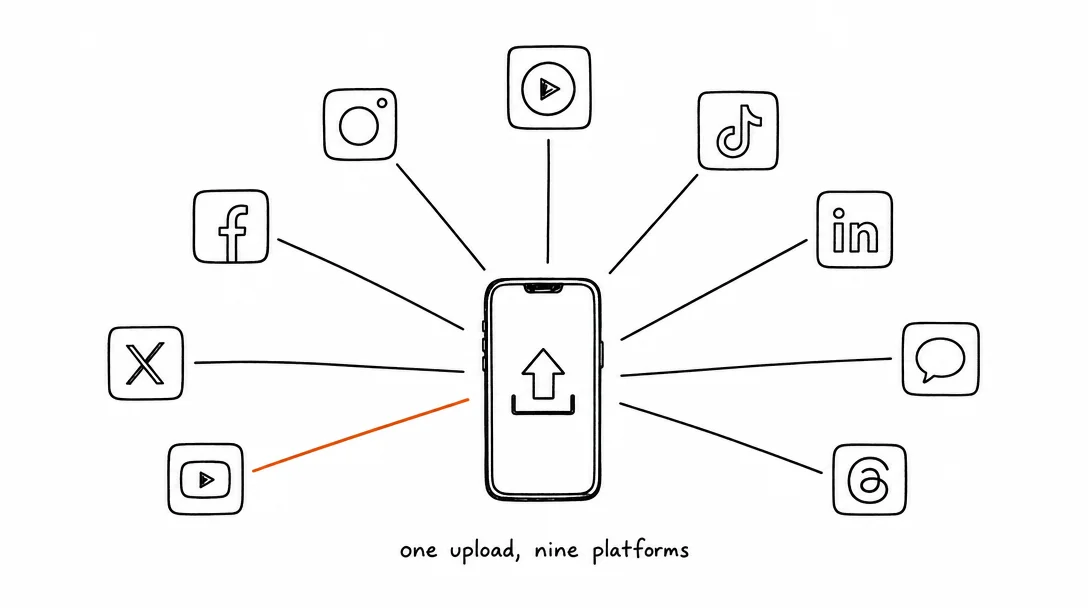
Apr 26, 2026 · 10 min read
How to Post to 9 Platforms at Once
Stop logging in 9 times. Schedule everything, Instagram, TikTok, YouTube, LinkedIn, and more, from one place.
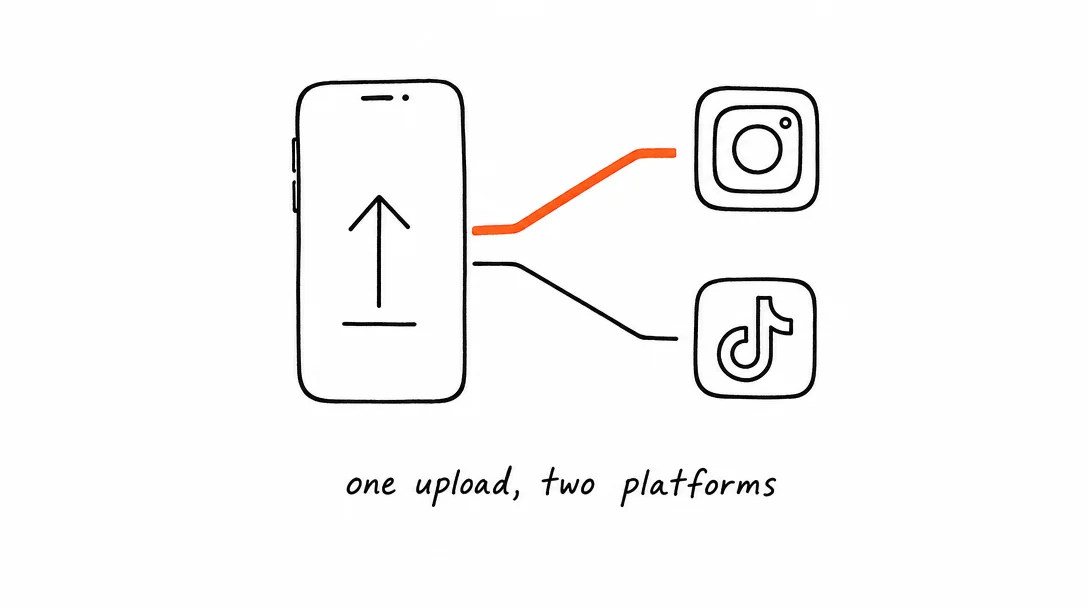
Apr 26, 2026 · 7 min read
How to Post to Instagram and TikTok at Once
Upload once and publish to both Instagram and TikTok simultaneously. No double-uploading, no app switching.
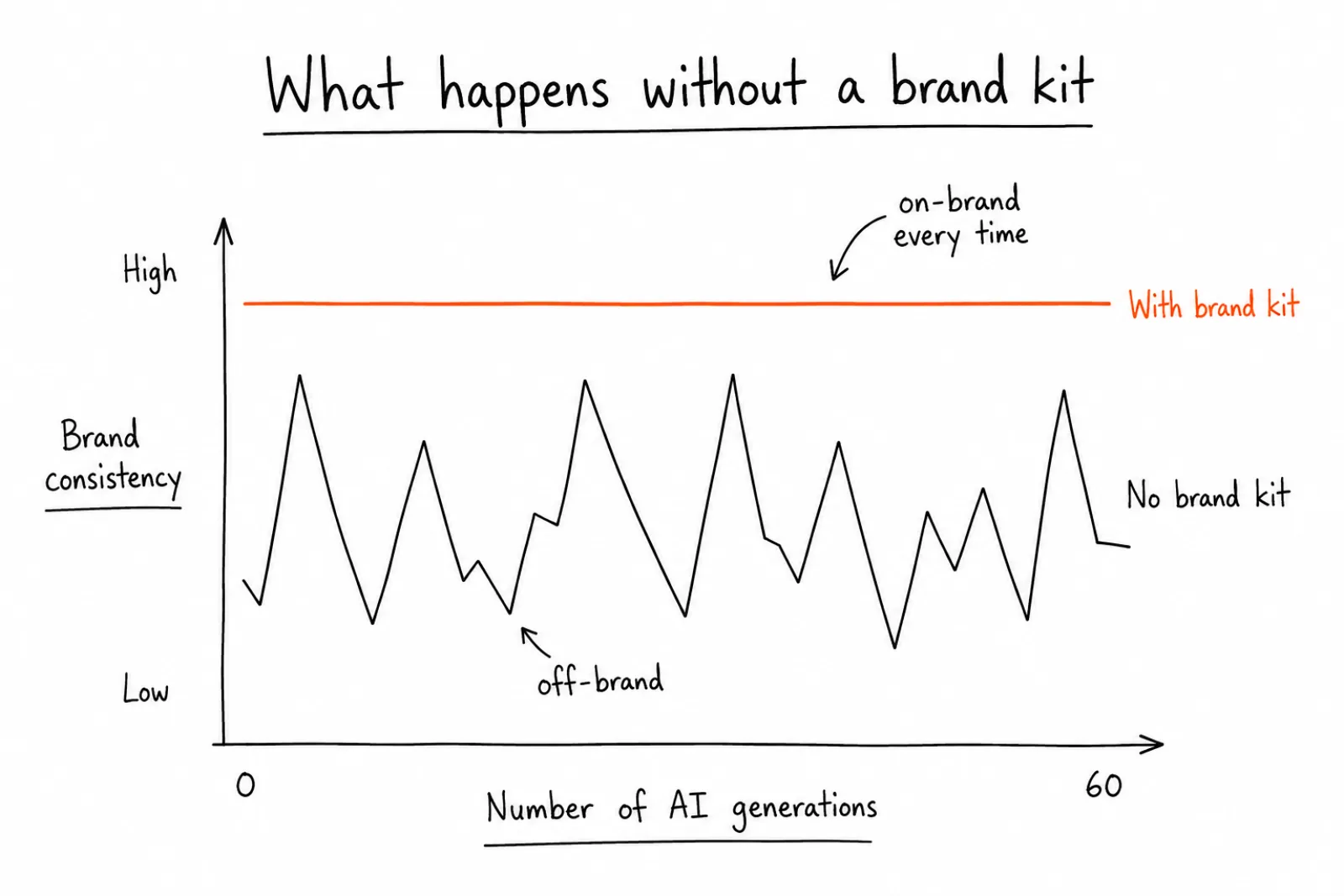
Sep 8, 2026 · 8 min read
How to Build a Brand Kit That Keeps Every AI-Generated Post On-Brand
A brand kit is the fix. It's a structured set of rules, colors, fonts, tone, logo placement, that an AI tool reads before it generates anything.
Your brand. One platform. Always on
Create, edit, and post from a single studio.
Start for freeSchedule TikTok posts at exactly the right time, automatically.